Ramón Carretero and the business of scarcity in Cuba
The Panamanian businessman, one of the favorite suppliers since the beginning of his mandate in 2013, was one of the intermediaries in the supply of products for Cubans in their worst moment of poverty. With the Cuban regime he set up a complex international plot that crosses half the world, allows him to bill millions, and markets everything from luxury vans to those equipped with air conditioning and milk substitutes.
A replica of Fidel Castro's funerary stone advances through the crowd gathered on May 1, International Workers' Day, in the Plaza de la Revolución in the city of Santa Clara, Cuba. An electric tricycle that moves slowly, to the rhythm of the people, carries it on the roof and, from the windshield, an image of the dictator leads the march.
The vehicle bears the Rali logo, a brand that in a few years was integrated into the island's urban landscape as an alternative to the fuel crisis and the deterioration of public transportation. One of the founders of this Panamanian company was Ramón Carretero Napolitano.
While strengthening its ties with the Nicolás Maduro regime in Venezuela, Carretero became an important supplier to the Cuban state in recent years, according to thousands of customs records reviewed for this investigation. The businessman established himself as a key intermediary in the supply to Cuba of products ranging from toilet paper to strategic goods for the industry, and built an international business network on a captive market supported by the shortages suffered by the island.
This research, carried out by Armando.Info in conjunction with Cuban newspaper, the Latin American Center for Journalistic Investigation (CLIP), Transparencia Venezuela and The Press from Panama, he reveals that Carretero companies have been important suppliers to the Cuban State in recent years. While strengthening his ties with the Nicolás Maduro regime, the businessman consolidated himself as an intermediary in the supply to Cuba of products ranging from toilet paper to strategic goods for the industry, and built an international business network on a market that is captive by the shortage suffered by the Island.
This research reveals a triangular business architecture that moved millions between 2021 and 2025. The products began their route in China or Turkey, then, a part arrived at the Colón Free Zone for subsequent re-export to Cuba; another part traveled directly to Cuba, with Panamanian companies as intermediaries in the operation. This framework made it possible to apply surcharges of up to 300% to merchandise that ended up in business structures of the Cuban State or in the hands of members of the ruling elite.
In those five years, Carretero's companies made sales of more than 11 million dollars, which were made to a dozen strategic sectors of the Cuban economy, including energy, construction and services. The network linked to the businessman also includes the start-up of a retail store online that it sold food, cleaning supplies and other consumer products at dollarized prices, unpayable for the island's salaries, but which were purchased with credit cards by Cuban exiles for their families.
The identity of the supplier adds another dimension to the business. Carretero is not an unknown international merchant nor an operator dedicated exclusively to the Cuban market. On December 11, 2025, The United States sanctioned him along with members of the Maduro-Flores family for integrating a network that, according to the Treasury Department, helped the Venezuelan regime circumvent restrictions on international oil trade.
Days later, on December 19, 2025, the Treasury Department he added to the sanction to Vicente Carretero Napolitano and Roberto Carretero Napolitano, Ramón's brothers. For years the three brothers have held management positions in various companies, but Ramón Carretero Napolitano was the one who forged the closest relations with the regimes of Cuba and Venezuela.
Since 2014, Carretero's companies have obtained more than 800 million dollars in contracts with Chavismo for infrastructure projects in that country. An investigation by CLIP and allied media revealed in May 2025 that, at the same time, the family environment of the then first lady, Cilia Flores, received transfers from Panamanian companies, who was also one of the main beneficiaries in the international oil trade: three offshore companies linked to the businessman carried out PDVSA exports for about 2.6 billion dollars.
Why, among thousands of international suppliers, did the Cuban system channel million-dollar operations precisely through the Carretero network? The documentation obtained in databases specialized in international trade, such as ImportGenius and Panjiva, exposes the pattern of commercial triangulation, intermediation and surcharges used by Carretero companies in Cuba. The Panamanian knew how to use the necessary resources to become one of the favorite intermediaries of the power groups on the Island.
A network to supply Cuba
The key company to understand Carretero's operations in Cuba is Corporación Logística ZLC SA. This partnership is repeated in hundreds of “bill of lading” (B/L or bill of lading, in English; official documents issued by shipping companies during their international shipments to control their cargo) that were reviewed for this investigation.
The company was established in 2019 in the Colón Free Zone, in Panama, one of the main trade centers in Latin America, with a tax benefits regime. From there, Corporación Logística Zona Libre de Colón functioned as an intermediary between international manufacturers, especially Chinese, and the Cuban market. The customs records examined show that all the company's identified exports have a single destination: Cuba.
ZLC Logistics Corporation sent more than 200 vehicles to the island, some with unit values greater than $121,000, according to customs records. In the first stage, cars from brands such as Toyota, Hyundai, Ford and Lexus predominated. But the export profile changed in 2024 to favor commercial vehicles, such as excavators, bulldozers, crane trucks and road tractors. Machinery and vehicles destined for sectors under direct State control gained weight in shipments.
The dimension of the network built by Carretero is better understood when its beneficiaries are known. Three large Cuban state corporations concentrate more than half of these operations: Multiservi SA, a foreign trade company in charge of channeling imports for different state organizations, concentrated vehicle purchases for more than 1.3 million dollars between 2024 and 2025, equivalent to 38% of the total registered value.
It was followed by Imeco, a company attached to the Ministry of Construction (Micons), with acquisitions of more than $548,000 in 2024 (15% of the total), which included trucks, utility vehicles, sedans, minibuses and a bus. In third place, the Tabacuba Business Group, with machinery valued at just over $510,000, reaches 14% of operations.
In addition, the Petroleum Supply Company (Abapet), the importing arm of the Cuba-Petroleum Union, acquired heavy machinery for more than $482,000 between 2024 and 2025, destined for the oil and energy sector. The operations coincide with a plan with Chinese participation to exploit crude oil and natural gas resources in the western part of the Island.
An operation allows the route of the products in the Carretero network to be precisely exemplified. On November 20, 2025, in the midst of the Cuban energy crisis, Corporación Logística ZLC dispatched a Shacman X3000 tanker truck to Cuba. The recipient was the import-export company of technical supplies Emiat, an entity subordinate to the Ministry of the Interior that, in the 80s, traded with companies of the Stasi (the secret police of the former communist Germany) and, later, operated in the Venezuela of Hugo Chávez as a purchasing center of the Cuban State.
The truck —the only one of its kind in the customs records consulted— had arrived in Panama from China. The supplier, Borey Investment Limited, supplied it to the Panamanian Aceros y Equipos Pesados Panamá SA for a declared value of $50,470. This last company has had commercial ties with Landscape Vision Corporation (Lanvicorp), linked to Ramón Carretero, and with Joy Kie Technologies, historical supplier of the companies Distribuidora Rali, Corporación Logística del Caribe and Lanvicorp itself, according to stock market documents from Joy Kie Technologies.
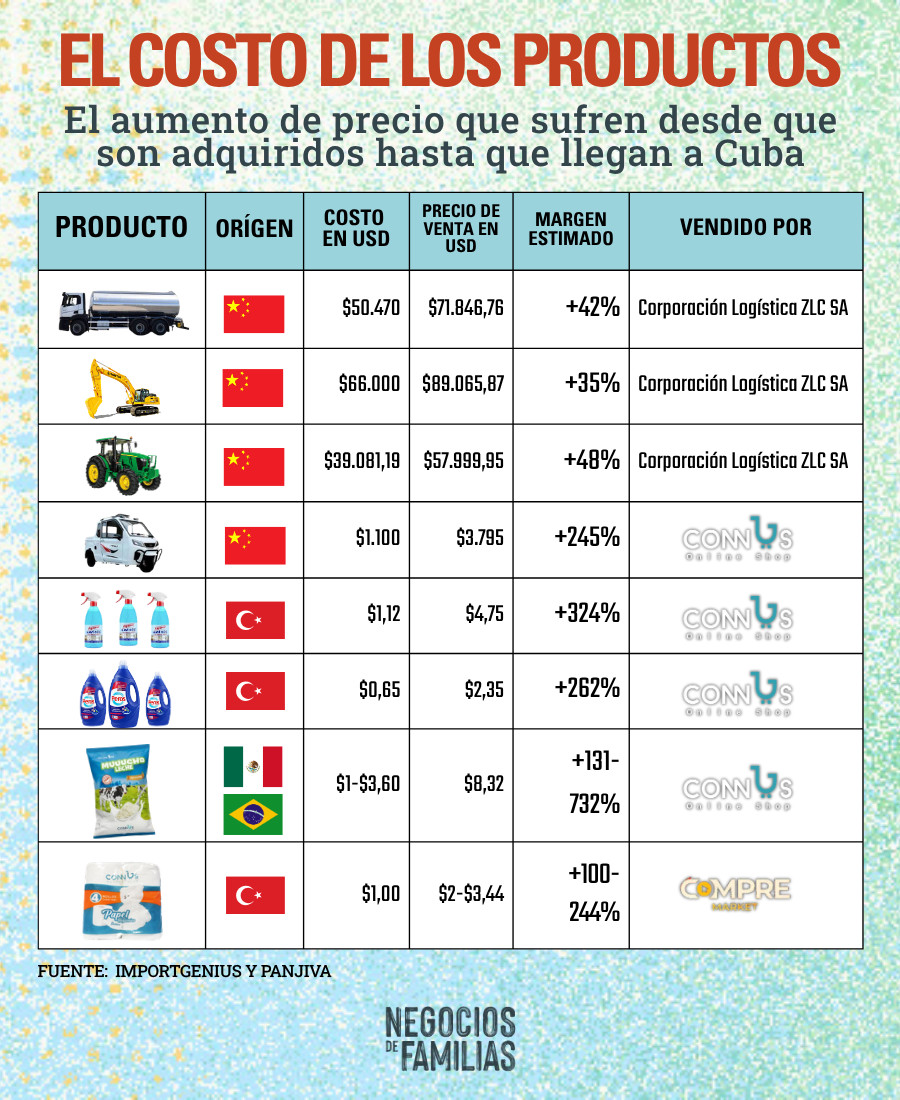
Weeks after its arrival in Panama, the vehicle left for Cuba through Corporación Logística ZLC. New declared value: $71,846. While passing through Panama, the price of the truck increased by 42%. This case is no exception. In similar operations with vehicles and machinery analyzed for this investigation, declared prices increased to almost 50% from their entry into Panama until their re-export to Cuba.
Going to an intermediary has a cost. Transportation, insurance, storage and financing can explain part of the increase in the price of a commodity. But the recurrence of the same companies, suppliers and trade routes in successive operations draws a pattern: a consolidated business structure that, in this case, thrives in an environment of scarcity and economic restrictions.
Why does the Cuban state system channel these diverse purchases into a single intermediary, instead of acquiring goods directly from manufacturers or comparing prices and relying on multiple suppliers?
In an open market, competition limits an intermediary's ability to raise prices. A buyer can negotiate with the manufacturer, change suppliers or seek better conditions. But Cuban foreign trade —in the country there is no publicly accessible platform to view tenders or price contests for public sector contracting— works under other rules.
For decades, the Cuban government has restricted the access of companies and citizens to direct imports and concentrated a good part of foreign trade in authorized entities. Access to foreign currency, import channels and supply to strategic sectors remain subject to state structures, such as Multiservi, Imeco, Abapet and Emiat.
The Cuban State has made Carretero companies a key international supplier. The Panamanian businessman was known in Cuba long before his name was associated with the businesses of Chavismo. Corporación Logística del Caribe, its flagship company, has operated a branch on the island since 1996, the same year in which the Regulations for the Registry of Foreign Companies were published. The company appears in the list of operators registered in Cuban free zones included in Resolution 33/97 of the General Customs of the Republic and published in the Official Gazette on February 6, 1998.
The Cuban branch was authorized to work in both the Wajay Free Trade Zone and the Havana Free Trade Zone, in Berroa, both in the Havana area. And he stayed. Their licenses were renewed for years. In 2022, the company was still listed as a trade representative office authorized by the Ministry of Foreign Trade and Foreign Investment.
Its network expanded in Venezuela starting in 2013. First came the public contracts delivered by Maduro's entourage and then oil trafficking, in which the Cuban regime also became involved. Later, in December 2025, the brothers Ramón, Vicente and Roberto Carretero they were sanctioned by the United States, which included them on the list of the Office of Foreign Assets Control (OFAC).
By then, other documents had begun to reveal points of contact between Ramón Carretero and figures at the top of Cuban power. On September 24, 2025, a Learjet 55 plane used by the businessman crashed and burst into flames while trying to take off from the Simón Bolívar International Airport in Maiquetía, Venezuela. The businessman survived, but two crew members died in the accident.
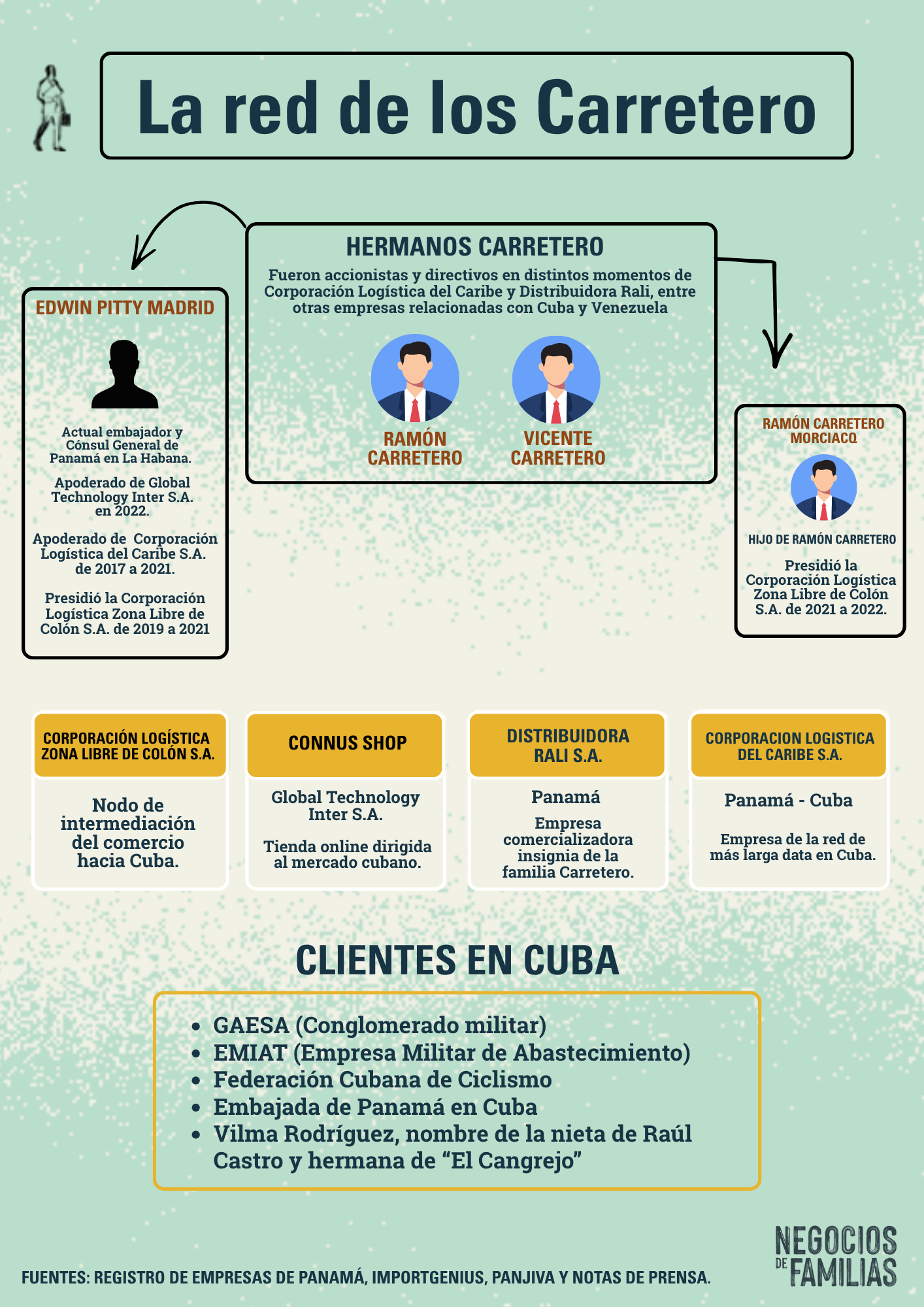
Previous movements of that same plane revealed that another frequent passenger on the aircraft was Raúl Guillermo Rodríguez Castro, The crab, grandson of Raúl Castro, former head of his bodyguard and son of the late General Luis Alberto Rodríguez López-Calleja, who for decades led the powerful Gaesa conglomerate, the holding from military companies recently sanctioned for Washington.
Rodríguez Castro had used that same plane to travel between Cuba and Panama on multiple occasions. In one of them he was accompanied by Brigadier General Ania Guillermina Lastres Morera, López-Calleja's successor at the head of Gaesa. Also, Carretero and The crab they also appear as frequent passengers of another aircraft, a Hawker 800XP with Panamanian registration HP-715.
These touchpoints extend to business operations.
Three of the Cuban imports analyzed for this investigation are addressed to Vilma Rodríguez, a name that coincides with that of a granddaughter of Raúl Castro, sister of The crab. Distribuidora Rali —the same company that manufactures tricycles like the one that carried the replica of Fidel Castro's monolith— shipped, in the name of Vilma Rodríguez, air conditioners, furniture and other household items for $5,000 in August 2016, according to the records. shipping records.
At that time, Vicente Carretero was acting as president of Distribuidora Rali after replacing his brother Ramón the previous month, a position in which he remained until December 22, 2025, according to documents from the Public Registry of Panama. The operations coincide with the period in which Castro's granddaughter was linked to a tourist lodging business in Havana, according to the media CyberCuba.
The available documentation does not demonstrate in which instance of the Cuban system it was decided to channel million-dollar operations through Ramón Carretero's companies. It also does not identify officials who participated in supplier selection or who approved purchases. But they do rule out that Carretero was unknown to the circles of power in Cuba.
In fact, the last imports made in the name of these companies that this alliance was able to see were registered on December 26, 2025, just a week before the capture of Nicolás Maduro and the tightening of the policy against Venezuela and Cuba by the Donald Trump administration.
Ramón Carretero and his lawyer were contacted to obtain their versions, but decided not to answer the questions of the reporters from that alliance. For his part, Vicente Carretero assured that he has not had any commercial relationship in Cuba. "As far as Distribuidora Rali SA is concerned, neither I nor I have ever done business with Cuba", he stated in an email sent on August 17. He also said that he has no companies registered on the island or links to power: "I have not had any relationship with the Cuban government". The businessman clarified that he also has no relationship with Corporación Logística del Caribe.
After publication of the research Family Businesses in May 2025, Ramón Carretero sued journalists from Armando.info. Vicente Carretero also denounced members of the newspaper The Press last month, after publishing the latest story about this research. He did so in relation to his business of renting offices to Panamanian Government entities at the same time that he was placed on the Clinton List.
Founded in 1993 by brothers Ramón and Vicente Carretero, Distribuidora Rali registered at least 36 exports to Cuba from Panama between 2012 and 2016, according to customs records. Although its original specialty is bicycles, the Panamanian company sent spare parts for automobiles, printers, fumigation equipment, construction materials and office supplies, among other items. The operation was always the same: Distribuidora Rali sent the products from Panama and, in Cuba, they were received by Corporación Logística del Caribe, according to the details of the shipping documents.
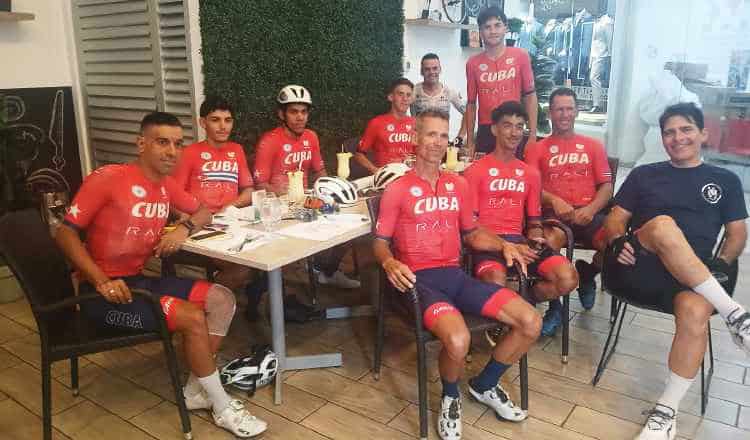
There was one last operation in May 2019. Distribuidora Rali sent 460 packages of bicycle tires to the Cuban Cycling Federation through the Marketing and Importing Company of the National Institute of Sports, Physical Education and Recreation (Inder), a state agency subordinate to the Council of Ministers of Cuba. The brand ended up giving its name to the Cuba-Rali team that represented the island in the Tour of Panama. In fact, Vicente Carretero himself, then president of the Panamanian Cycling Federation, was photographed with the team in the 2025 edition of this competition.
The Rali brand established itself in the Cuban market with its bicycles, motorcycles and electric tricycles. Your products they are still marketed through Cimex and Tiendas Caribe, state chains of the Gaesa military conglomerate that, according to an official 2017 report, controlled 98% of retail trade in Cuba.
State companies too they promote on its official channels the Rali brand, whose Rio, Isla and Tornado model bicycles began to be sold, at least in 2020, for prices between 125 and 505 dollars. Since August 2025, Panamanian brand tricycles have been part of the fleet Ministry of Agriculture.
The Rali brand established itself in the Cuban market with its bicycles, motorcycles and electric tricycles. Your products they are still marketed through Cimex and Tiendas Caribe, state chains of the Gaesa military conglomerate that, according to an official 2017 report, controlled 98% of retail trade in Cuba.
State companies too they promote on its official channels the Rali brand, whose Rio, Isla and Tornado model bicycles began to be sold, at least in 2020, for prices between 125 and 505 dollars. Since August 2025, Panamanian brand tricycles have been part of the fleet Ministry of Agriculture.
The last link in the chain
Connus Shop was a store online with prices in dollars whose objective was to capture the foreign currency destined by Cuban emigrants to supply their relatives who remained in the great antilles. It was registered as Connecting Us Pty in Panama, which is the commercial name of Global Technology Inter SA. The commercial records of this company show the presence of operators linked to Carretero's environment, such as Luis Carlos Zambrano, who held the position of president when it registered as an Internet sales platform. The company was registered with address at the Sky Business Center in Panama, also known as Rali Business Center and owned by Vicente Carretero Napolitano.
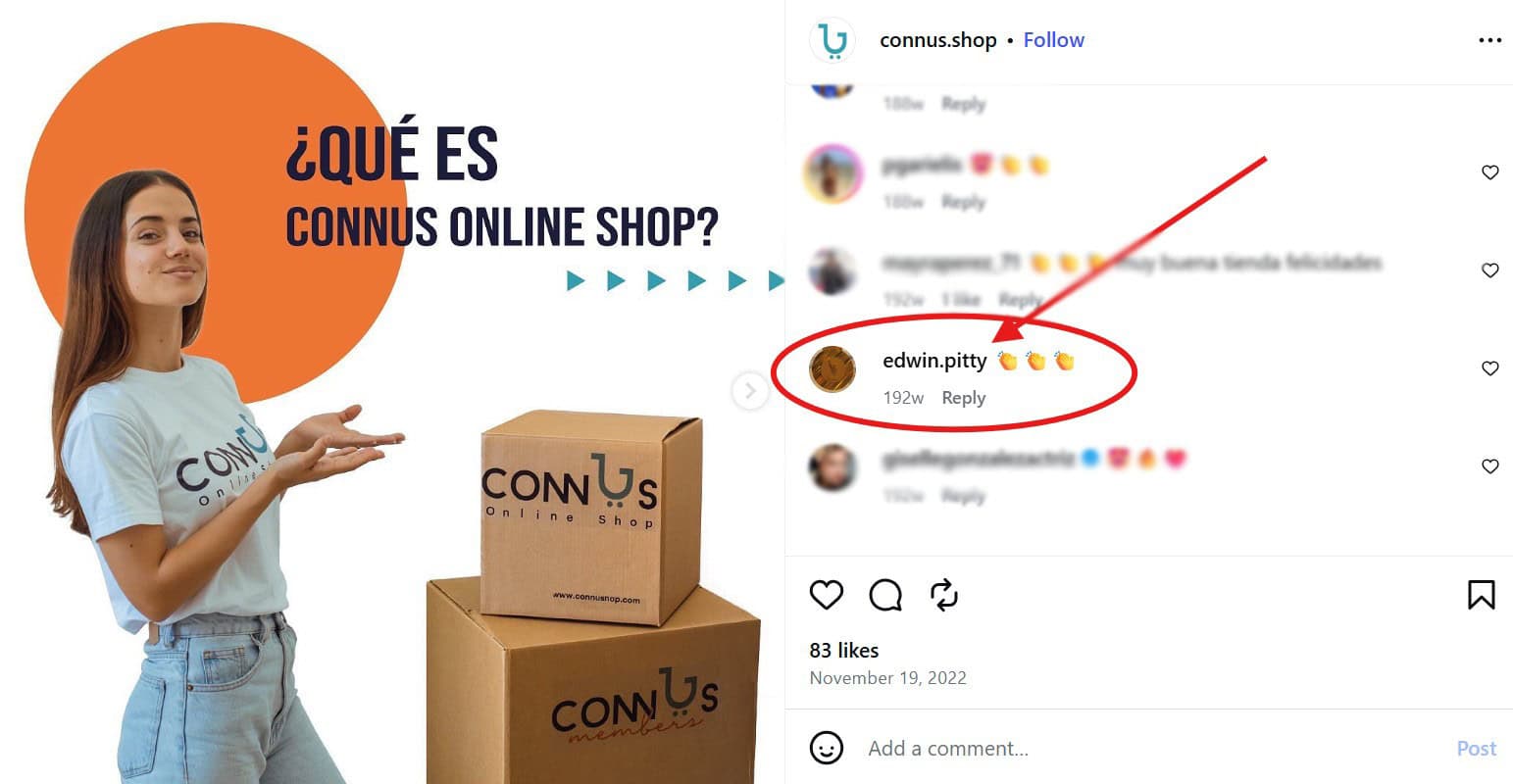
A key actor in understanding Carretero's businesses in Caracas and Havana is Edwin Pitty Madrid, current ambassador of Panama in Cuba and former representative of the businessman in Venezuela. Pitty Madrid acted as resident agent from Global Technology Inter in 2017, three years after its creation, and in 2022 it registered its own brand Connus in Panama as the company's representative. At the same time, between 2017 and 2021, he served as representative of the Caribbean Logistics Corporation, the flagship company of the connection with Cuba.
But the most significant connection appears in Havana, where, according to its website, it had a physical presence in the Port Ring, one of the main logistics enclaves of the capital, which is also home to Cimex's Electronic Commerce Division. There Connus Shop shares logistics infrastructure with different Gaesa sales portals aimed at the Cuban market, such as Puerto Envoy, Almacén-On and Carlos Tercero. These portals were grouped in the online sales platform ShippingCuba, formally registered as part of a Spanish company, and which also stopped operating at the beginning of June, at the same time as the Panamanian Connus Shop.
How do online stores work in Cuba? Mostly, Cubans from the diaspora make purchases online with credit cards and the products (previously imported and stored) arrive just a few hours later at the doors of their families in Cuba. Connus Shop's catalog was so heterogeneous that it ranged from personal hygiene items to pet medications and Rali brand vehicles, such as the tricycle that carried the reproduction of Fidel Castro's funerary stone in Santa Clara.
Connus Shop hired foreign suppliers, mainly from Turkey, to source generic goods that were then repackaged and sold under its private label. This allowed it to control the commercial image and maximize profit margins by distributing products through its own internal logistics networks to the Cuban retail market. He put together a model that connected platforms and payments managed from abroad with storage, order preparation and distribution within Cuba.
Turkey's hygiene and mass consumption products business invoiced at least 24 million dollars since the end of 2022.
The model stands out for its profitability, with increases of up to 324% in the cost of high turnover products. A revealing example is the Asperox Blue Power cleaner, whose factory cost is just one dollar, but which is sold on the island for $4.75. This difference generates a gross profit of $3.75 per unit. The commercial margins of toilet paper, labeled under the Connus and Drop brands, exceed 63%.
The rise of commerce online in Cuba it occurred in 2019 with the creation of online purchasing portals in Freely Convertible Currency (MLC), a virtual currency created by the Cuban government, whose price is equivalent to the dollar. The e-commerce boom was consolidated after the Monetary Regulation implemented by the Government in 2021, and was strengthened since the Covid-19 pandemic. Although the Cuban authorities do not publish figures, the portal's calculations Statista Market Insights they point to a growth in electronic commerce close to 50% between 2021 and 2026.
This new business reflects a structural change in the Cuban economic model. Given the exhaustion of subsidies from the Soviet Union, first, and then from Venezuela, the regime has oriented a growing part of its financing strategy towards raising resources from the diaspora. The Rali tricycle is just one example of this scheme: it was marketed in July 2025 by $3,795 at Connus Shop, which is equivalent to 370 times the average salary on the Island.
The same product could be found at the Alibaba platform for 1,100 dollars.
The Panamanian embassy in Havana also imported supplies through Carretero, according to customs records. On August 29, 2024, two months before the appointment of Pitty Madrid, Corporación Logística ZLC exported a seven-seater truck worth $57,000 to the consular headquarters in Cuba. At that time and until January of this year, Pitty Madrid was listed as one of the subscribing lawyers of this company.
Despite US sanctions against the Carretero brothers in December 2025, Connus continued to operate as a virtual store in Cuba during the first months of 2026. However, its activity was interrupted on June 5, 2026 after the entry into force of the Executive Order 14404, signed by the Trump administration. This provision authorizes sanctions against banks, payment processors and foreign companies that maintain commercial relations with Cuban entities included in the sanctions list, including Gaesa.
“Lots of milk” which is not milk
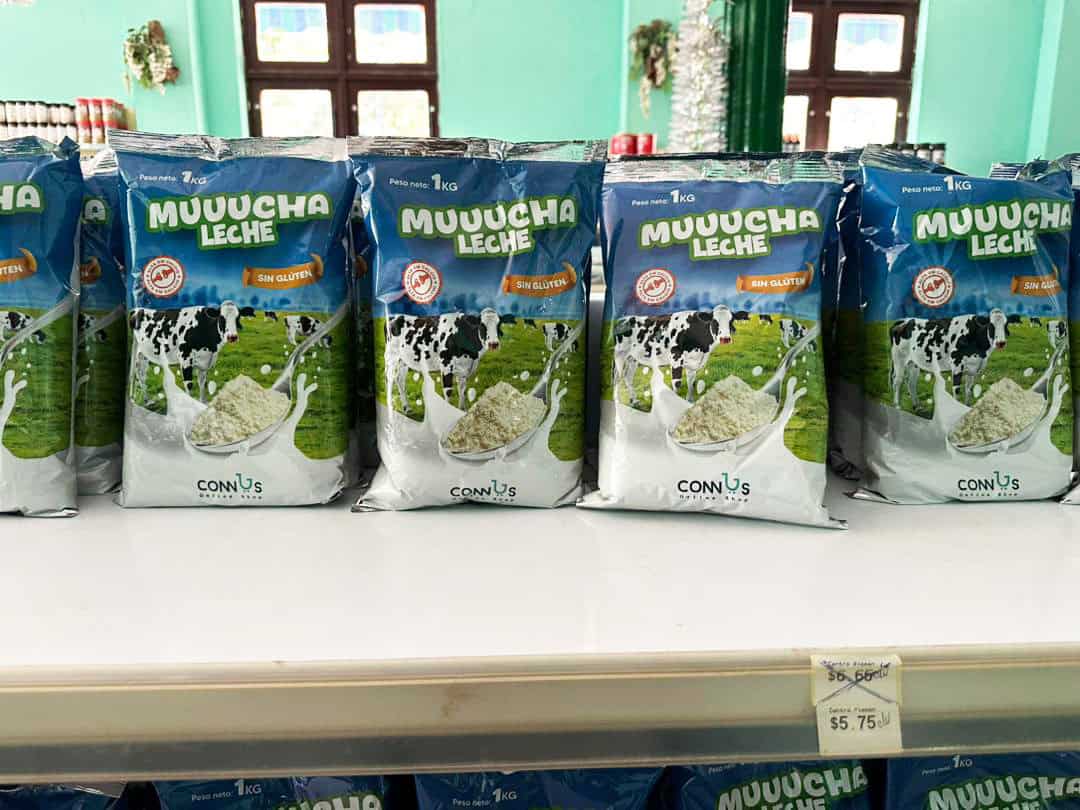
Another item that Connus Shop sold was Muuucha Milk, a dairy preparation available in online stores for 8.35 dollars per kilo. This product, which is sold at more than double its cost, is manufactured by the Brazilian company Alibra Ingredients SA., but it reaches the Cuban market imported through the Carretero network. One kilo of Muuucha Leche is equivalent to more than 80% of the average monthly salary in Cuba.
But its nutritional value does not meet international standards Codex Alimentarius prepared by United Nations and the World Health Organization (WHO), which were adopted by Cuba. The product contains just five grams of protein and 313 milligrams of calcium per 100 grams, compared to 26 grams of protein and 950 milligrams of calcium in conventional whole milk powder. This means that a Cuban child would have to consume more than five glasses of this preparation to obtain the protein provided by a single glass of milk.
The composition of Muuucha milk includes high levels of carbohydrates, vegetable fats, glucose syrup and maltodextrin. Although it is marketed under a suggestive name, the label itself avoids calling it milk and technically classifies it as "food preparation powder".
The replacement of milk with whey and fat mixtures to maximize profits has already been used in Venezuela with the products of the CLAP boxes linked to Alex Saab, Colombian businessman prosecuted in the United States for a money laundering scheme related to those Venezuelan public contracts.
Muuucha Leche was not only available in Connus Shop, but currently occupies the shelves of the Cadena Caribe and Cimex stores, both controlled by the military conglomerate Gaesa.
Milk was historically a pillar of food policy and a symbol of the social model of the Cuban Revolution. For decades, its subsidized distribution to children and pregnant women was a priority. However, the collapse of state production and strong restrictions on the private sector sank national production, no longer able to cover this priority demand.
At the same time, the expansion of the commercial circuit in Freely Convertible Currency (MLC) and the rise of online sales platforms aimed at the diaspora displaced the bulk of the supply of milk —or its substitutes— towards the dollarized market.
The shortage that Cuba suffers already transcends its original causes. By limiting supply alternatives and maintaining a captive demand for essential goods, the Cuban government has created the conditions so that international intermediation like that of Ramón Carretero is part of the same mechanism with which a lot of money can be made in times of need. critics.



Post A Comment
No comments :